OPERATIONS AND TECHNICAL STRATEGY  HOW DO PEPSI OPERATE THEIR PRODUCTS TO ATTRACT THEIR CUSTOMERS???
Present StrategyRoger Enrico the CEO of PepsiCo (1996-2001) got involved in restructuring PepsiCo’s business portfolio. Company had 3 business segments restaurants, beverages and snack foods. Enrico found that there are number of fairly serious problems at PepsiCo. The company’s beverage business began to fall behind Coca Cola (competitor) by a growing margin in both domestic and international markets. The restaurant’s business was declining and profit margins were narrowing. Amid of all these problems Enrico developed a restructuring strategy, which is as follows:
The restaurants limited investment in the company’s snack food and beverage business and severely impaired the corporation’s overall operating and profit margins. Considering these facts the restaurants which included Pizza Hut, KFC and Taco Bell were eliminated from the company’s portfolio of business and the three main restaurants were spun off as an independent publicly traded company , the divestitures was completed with a creation of Tricon Global Restaurants. Company was focusing on related diversification and spun off business unit which were unrelated to the core business of beverages and snacks.
Outsourcing of Bottling Operations: company spun off more than 50% of its bottling operations around the world and gained a 1million$ gain on theinitial public offering. This was done so that the company could be more focused and specialized in the development of new products and marketing programs to support them.
The recent strategy was to achieve annual cost savings by reorganization of activities in the value chain of the company’s snack and beverage businesses. This included combined corporate worldwide procurement, combination of Gatorade and Tropicana hot fills, joint distribution of Quaker snacks and Frito Lays products and synergies between Frito Lays international and PepsiCo beverages.
All this resulted in tremendous growth of PepsiCo, as it became the second largest food products company inUnited States. Company was diversified into salty and sweet snacks, soft drinks, orange juice, bottled water, ready to drink teas and coffees, nutraceutical and isotonic beverages, hot and ready to eat breakfast cereals. All these brands held number one or tow positions in their respective food and beverage categories. PepsiCo is operational globally and all the divisions are competing in domestic and international markets. Thus these are the above-mentioned steps, which are undertaken by the current management to exploit the opportunities and to restructure the company.
1.Divesting of Restaurant business: PepsiCo’s competitive success in its 3 industries was due to its ability to create a distinctive image and to develop innovative and tasty new products. The inclusion of quick service restaurants was the most distinctive characteristic of PepsiCo ‘s business portfolio. Company formed the largest restaurant conglomerate in the world, KFC, Pizza Hut and Taco Bell, collectively had worldwide sales of $11.5 billion in 1995. Company had the strategy of acquiring established market leaders but later it also acquired small, relatively unknown companies. This industry was appealing because the changing demographic factors like two income families increase in the number of households made up of singles mad eating out an attractive alternative. US fast food sales grew at an annual rate of 6% between 1990-1996 but this also lead to increased competition and price wars.
PepsiCo decided to spin off the restaurant business for the following reasons: External Factors:
Internal Factors:
Company spun off more than 50% of its bottling operations around the world and gained a 1million$ gain on the initial public offering. This was done so that the company could be more focused and specialized in the development of new products and marketing programs to support them.
Determine the competitive advantage potential of any value chain relationship and strategic fits among existing business: 1.Firm’s infrastructure: General Management: Enrico 56 year old CEO of the company retired in 2001 , he was succeeded by Steve Reinemund who joined PepsiCo in 1984 as a Chief of the Pizza Hut business. Finance: PepsiCo was the fifth largest food and beverage company in the world. Value of its shares improved from about 30$ annually in 1997 to over 45$ in late 2001. Strategic planning: PepsiCo was operating in three businesses, beverages, snacks and restaurants. Enrico the CEO of PepsiCo (1996-2001) proposed to spin-off the restaurant business, as it had nothing to do with the snack and beverage business of the company. The restructuring of the company laid emphasis on related diversification in cereals and juice industry. 2.Human resource development: The best managers of the company were rotated from positions in one business unit to assignments in the other two business segments to promote the transfer of skills, practices, know-how and innovative ideas from one business to another. It kept the managers’ thinking fresh and innovative and developed the skills of the employees. 3.Technological development: PepsiCo is restructuring its value chain activities by combining the snacks and beverage’s manufacturing process. This would result in achieving economies of scope and will give the company competitive advantage. It had its own agriculturists who helped guide the farmers / suppliers of potatoes about the agricultural techniques . It had its own proprietary agro technology. 4.Procurement: PepsiCo has also developed a sophisticated value chain alignment tracking process that utilizes online scorecards. These cards are updated monthly to track over 130 individual projects designed to capture synergistic benefits and to record the supplies of each product. Company was starting off with combined procurement of all its business products for ingredients and packaging materials which would result in an estimated $160 million in cost savings by 2005. Key Success Factors for PEPSI
There are more chances for the companies to sell their products in new markets likeEast Asia,North AmericaandEurope, and also inNorth Africacompanies have a big market to cater.
The distribution channels and the production should be optimized in such an efficient way that whenever there is a required demand, it should be fulfilled on time basis.
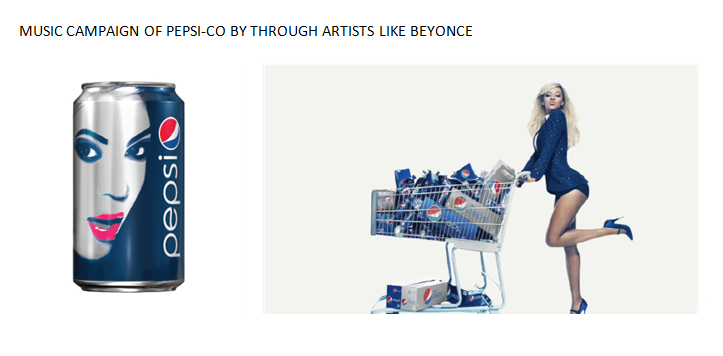
Introducing renowned celebrities in the advertisements of beverage ads is one of the leading factors for the companies to succeed in the market.
Most of the people are health consciousness about their health and light beverages is a growing market for this segment. |

Make a Free Website with Yola.
